Showing posts with label Yorkshire. Show all posts

Monday, 6 June 2011

Bird Sightings: POPULATION OF BLACK GROUSE RISES DRAMATICALLY IN TEESDALE

THE population of rare black grouse in upper Teesdale has risen dramatically.
But while the iconic upland bird is fighting back in its North Pennines stronghold, extinction is looming in north-west Northumberland, where just six birds are left.
Northern England suffered a devastating decline in the population last year. But the early morning spring counts just completed by researchers from the Game & Wildlife Conservation Trust show that the 2010 population of 500 males has grown to 820 in the North Pennines.
Fran Atterton, the trust’s black grouse project officer, said: “Overall these are fantastic results and are a credit to the huge amount of conservation work that has been invested in our moorland fringes over the past 15 years by moorland managers, farmers and gamekeepers to improve the conditions for black grouse so that when weather conditions are good in June when the chicks hatch they breed well.” 
However, she said further work is still required to safeguard this bird in northern England.
The trust has recently launched a project, funded by the Heritage Lottery Fund, to encourage landowners to establish small pockets of woodland to provide an emergency food source and cover in severe winters.
The fortunes of black grouse were affected by a series of weather related set-backs over the past few years. After celebrating a high of 1200 males back in spring 2007, the wet June weather in both 2007 and 2008 caused high mortality in newly hatched chicks.  This was compounded by the exceptional snow fall and freezing temperatures of winter 2009/10 causing the population in northern England to crash to an all-time low of 500 males.
Despite the good news in Teesdale, black grouse in north-west Northumberland have collapsed from 100 males in 2002 to only six this spring and are now facing imminent extinction.
In the Yorkshire Dales, black grouse have increased from 90 to 131 males after males were moved to this fringe area.
Dr Phil Warren, the GWCT scientist in charge of the project said, “The results of this trial have certainly been heartening because it is helping them to expand their range into former haunts.  We are now seeing males carrying out their unforgettable mating display in areas where they have been absent for 15 years or more.”

Friday, 3 June 2011

Bird Sightings: Shivering call of wood warbler is heard again in Yorkshire


It is a woodland birdsong like no other.
The strange shivering call of the male wood warbler, compared by some to the sound made by a spinning coin on a marble slab, is being heard again in Yorkshire woodlands.
Up to six have been reported in Strid Wood, Bolton Abbey, North Yorkshire compared with only one last year – I saw three there this week – while at least one is back at Hardcastle Crags near Hebden Bridge.
The song is delivered in two phases, first a soft but penetrating whistle, then a series of notes that gradually quicken and intensify into a loud spluttering cascade of sound.
The song is repeated every few minutes as the male moves among the tree canopy and can be heard from dawn until dusk.
The wood warbler is the largest of our three “leaf warblers”, the others being the chiffchaff and willow warbler, and also the rarest.
It is also the most brightly coloured, green above with a yellow throat and pure white underparts which blend in with the bright green beech and oak leaves from where it delivers its song.
This preference for tall beech and oak trees with few lower branches or undergrowth beneath them means that the wood warbler has to nest on the ground, building a domed nest of grass in a hollow.
The increase in numbers at Strid Woods this year is encouraging, given that there is great concern over the decline of the wood warbler nationally.
Over the past 20 years they have disappeared from many areas such as East Anglia where they once returned regularly each spring.
About a third of the British population is found in Wales and here the RSPB is carrying out a survey which began in 2009 and will continue until at least next year to study the wood warbler’s feeding habits, breeding success etc and see if more can be done to help them.
Wood warblers are on their way back to Africa by mid September and are unusual in that they fly south west to northern Italy where they feed and put on weight for several weeks before they continue south, possibly across the central Sahara to as yet undiscovered wintering grounds further south.
Birdwatchers followed the progress of a massive white-tailed eagle along the Yorkshire coast on Sunday as the juvenile bird was seen flying south from Hornsea Mere, down to Aldbrough and then across the Humber to Lincolnshire from Sammy’s Point.
A first summer golden oriole was singing at Sammy’s Point and another was heard at Grimston while a bee eater was seen at Spurn and Kilnsea.
Three red-rumped swallows were seen at Spurn while a tawny pipit was near Easington Lagoon where it was caught and ringed, a water pipit was also present there.
Quail were seen at several coastal sites with two flushed from a field at Flamborough, two heard and seen at Clubley’s Field, Spurn and one heard at Buckton. Their distinctive song should be listened out for now from among crops.
A corncrake flew in off the sea and into a dense stand of buckthorns at the Warren, Spurn, the first spring record there since 1992.
Two Temminck’s stints were seen on Port Clarence Pools on Teeside while others were at Bewholme Hall pond East Yorkshire and at Boston Lake, Hatfield Moors, South Yorkshire

Source: Yorkshire Post


Have you Seen a Wood Wardbler? Leave a comment below!


If you have seen any rare or unusual wildlife we would love to hear from you, please email wildlifesightings@hotmail.co.uk

Got a picture of something but unsure what is its? Send it in and we will put it on the site for people to try and identify! 

Friday, 27 May 2011

Bird Sightings: Rare osprey seen in Ranworth


Osprey. Photo credit: WildStock


By Lucy Wright
The bird from Africa is using the fish-rich waters of the reserve as a good place to stock up before continuing its migration north, possibly towards a final destination of Scotland or Scandinavia.
Although the impressive fish-eating bird of prey, which has a 1.5metre wingspan, can sometimes be viewed distantly from Norfolk Wildlife Trusts’s floating Broads Wildlife Centre, the osprey favours the far end of the Broad meaning that the best chance of seeing it well is from one of NWT’s guided wildlife boat trips.
Norfolk Wildlife Trust spokesman, Ed Parnell, said: “It’s impossible to say how long the osprey will stay at Ranworth, but for now at least it doesn’t seem to be a hurry to carry on its long journey.”

Source: www.edp24.co.uk

Thursday, 26 May 2011

Big Cat Sightings: 30 big cat sightings reported to Durham Police over past 11 years

By Duncan Leatherdale


MORE than 30 big cat sightings have been reported to police in County Durham in the past 11 years but officers in many cases said they could find no evidence of the mysterious moggies.

The large felines, often likened to pumas, panthers or jaguars, have been spotted around the county, from Stanley and Chester-le-Street to Darlington and Teesdale.

A Freedom of Information request to Durham Constabulary has revealed 33 sightings have been reported to police since the beginning of 2000, although several were categorised as hoax calls.

In September 2002 police went to Maiden Law near Durham where they found a disembowelled horse, with the owner fearing it had been attacked by a large cat.

Upon investigation however officers concluded that he horse had injured itself on a broken wooden fence nearby.

Police were also called to several other animal mutilations, including the carcasses of three sheep near Barnard Castle on December 30 last year.

The caller said the sheep had been "eaten rather than butchered" and that all that remained were their fleeces.

On October 4 last year officers also found a sheep with its front legs and half of its neck missing but on neither occasion did they find evidence to say a large cat was responsible.

In April 2006 a sheep near Durham survived having its sides lacerated, large cat like footprints were found in the mud around it. The latest sighting was in a wood in Durham in January when a dog walker reported seeing a "possible puma" at about 7pm.

Sightings have also been reported from Peterlee, Sedgefield, Ebchester, and Crook with four sightings made around Bishop Auckland between April 2004 and September 2005 and seven around Durham City since 2001.

Often the animal is compared in size to a large dog, ranging from Alsations and Labradors up to a Great Dane.

Meanwhile in Yorkshire the carcasses of two sheep, stripped to the bone, were discovered in a field near Kirby Hill, Richmond, causing speculation that a wild big cat, dubbed the Durham Puma, was prowling around Weardale and the Yorkshire Dales.

A police spokesman said big cats sightings are rare.

He said: "Reports of sightings are followed up as appropriate, but over the years no firm evidence has ever been found to suggest a panther or similar big cat has been living wild in County Durham."

Source:http://www.thenorthernecho.co.uk/news/9048539.30_big_cat_sightings_reported_to_Durham_Police_over_past_11_years/?ref=rss

Wednesday, 25 May 2011

Mammal Sightings: Hull garden home to 'world's oldest' wild common toad


The world's oldest wild common toad could be living in a garden in Hull, according to experts at the University of York.
Georgie the toad was introduced to a garden in the Greatfield area in 1973, to protect tomato plants against pests.
Scientists were told of the creature as part of a nature study and they believe it is at least 40-years-old.
Common toads can live for 12 years in the wild and up to 40 or 50 years in captivity.
University of York community scientist Sal Hobbs said: "As a young adult Georgie was given as a gift to a Hull resident as a way of protecting her tomato plants against pests.
"That was 38 years ago, so remarkably Georgie must be at least 40 years old now.
"Therefore, as a wild common toad of her age, Georgie might well be a world record-breaker."

Source: BBC News Humberside

Sunday, 22 May 2011

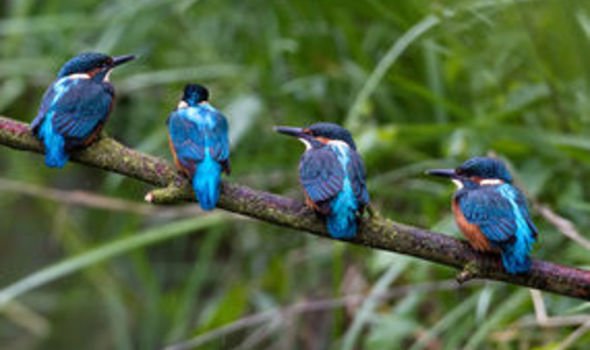
Bird Sightings: Four Kingfishers Together in Yorkshire

A rare treat down by the riverbank
The family of kingfishers near Fairburn Ings / 
Picture: OLIVER C WRIGHT


By Stuart Winter

TO see one kingfisher is always a joy and to see two together makes a day to remember.
Few birdwatchers ever get to see three of these dazzling river birds all in one binocular view but four in a row...

It is little wonder conservationists at the Royal Society for the Protection of Birds were cock-a hoop when this beautiful photograph dropped on the desk last week.

The idyllic riverside scene shows three young birds learning how to become the ultimate anglers close to the RSPB Fairburn Ings reserve near Castleford, West Yorkshire.

While the somewhat diffident father has his back to the camera, his three offspring – they can be identified by the pale tips to their spear-like bills – were more than happy to strike a pose for photographer Oliver C Wright.

Oliver was able to get his family portrait after the RSPB’s clever idea to allow the public to bask in the beautiful metallic blues and fiery oranges of the kingfi shers’ finery while ensuring the legally protected birds were not disturbed.

A screen with strategic apertures was put up alongside a waterway that skirts the reserve so wildlife lovers could enjoy the rare sight of the young kingfi shers being taught some of nature’s most spectacular hunting techniques, while the birds remained oblivious to the attention.

Laura Bentley, RSPB Fairburn Ings visitor experience manager, said: “Most people would be lucky to see one kingfisher in their lifetime, let alone four all together.

“In the winter the lakes and ponds were frozen solid for months so we were worried for our kingfishers not being able to get enough food, but seeing a whole, healthy-looking family is a great sign.”

Kingfishers are protected under the Wildlife and Countryside Act and have been “amber listed” as birds with an unfavourable conservation status in Europe, having suffered declines in breeding population over the past 25 years.

The latest research from the UK’s Breeding Bird Survey shows they have been enjoying a small success over the last decade – numbers up by more than seven per cent between 1995 and 2009 – but the worst winter in 30 years followed by one of the driest springs could have serious impacts this year.

Taking a look at a graph drawn up by the British Trust for Ornithology’s excellent BirdTrack recording system makes worrying viewing.

This year’s line falls menacingly below previous years’ sightings and may mean scenes as witnessed at Fairburn Ings are going to be even rarer this summer.

Kingfishers are among the most sedentary of birds and even in the coldest of winters have been seen to move only relatively short distances from their home fishing grounds.

Indeed, in 100 years of ringing by the BTO, there have been only 15 foreign movements recorded, with eight birds ringed abroad arriving in the UK and seven of our birds turning up overseas.

This means ensuring waterways are kept clean and pollution free is vital if our most beautiful native bird is to continue to brighten up the countryside with its brilliant electric blue colour scheme in years to come.

Thursday, 19 May 2011

Bird News: Strange-looking visitor is a first for reserve- Yorkshire


editorial image
Stone Curlew


By Bill Teale 
One of the strangest birds in the British countryside, the stone curlew, has paid a rare visit to the region.
It was present last Thursday at the RSPB’s Old Moor reserve, in South Yorkshire, a first for the reserve and the Barnsley area, before flying off in the late evening.
Presumably, the same bird turned up on Saturday afternoon at Port Clarence, close to the Middlesbrough transporter bridge, where it remained before disappearing again on Monday.
The stone curlew’s crouching stance and beady bright yellow eyes give it an almost reptilian look and support for the theory that birds are descendants of dinosaurs.
It also has swollen knee joints from which it gets its traditional name of “thick knee” but it is not related in any way to the curlew. The link comes from its loud quavering call which rather resembles that produced by our familiar moorland bird.
Stone curlews are a summer migrant, returning to England in late March and April from wintering areas in southern Spain and France and north and west Africa.
They are now found only on the Brecklands of Norfolk and Suffolk and in Wessex, although in the 19th century they bred in 23 English counties, including Yorkshire.
They were found, along with the great bustard, on the then vast expanse of chalk grasslands which made up the Yorkshire Wolds.
At one time, in the 1980s, the country’s stone curlew population reached a low of around 130 pairs but now, thanks to the hard work and co-operation of the RSPB, other conservation groups and landowners, the situation is much healthier.
A target of 300 breeding pairs by 2010 was, in fact, reached in 2005 with 336 breeding pairs the following year. The new target of 350 pairs by 2015 was again surpassed last year when there were 370 pairs.
Another conservation success is the common crane, and several of these large elegant birds have been seen across the region with a first summer bird arriving last week and remaining into this, at the Fairburn Ings reserve, near Castleford.
An adult was seen in fields near Buckton Hall, East Yorkshire, while two were at Sunk Island on the Humber.
Britain’s rarest harrier, the Montagu’s, has also been reported with one, along with four hen harriers, at Hoddy Cows Lane, Bempton, and males seen at Flamborough, Spurn and Potteric Carr, Doncaster.
A male red-footed falcon was seen at Spurn on Monday, and a serin and red-rumped swallow have been among other sightings there.
A spoonbill was seen at Hornsea Mere and one in flight over Bridlington Bay.
Waders, many such as knot and godwits in bright red summer plumage, continue to be seen on passage through the region, while there have also been more wood sandpipers with five at Wheldrake Ings and four at Edderthorpe Flash, South Yorkshire.
Some little and Temminck’s stints have also been reported with two of the latter on a pond at Bewholme Hall, East Yorkshire.

Monday, 16 May 2011

Wildlife Sightings in Yorkshire

What Wildlife have you seen in Yorkshire?

Whether its an Insect, Spider, Bird, Mammal, Fish, Mollusc, Reptile, Plant or Fungi let us know! 

Remember to add the location of the sighting and if you managed to get a photo, you can add it to your comment!